
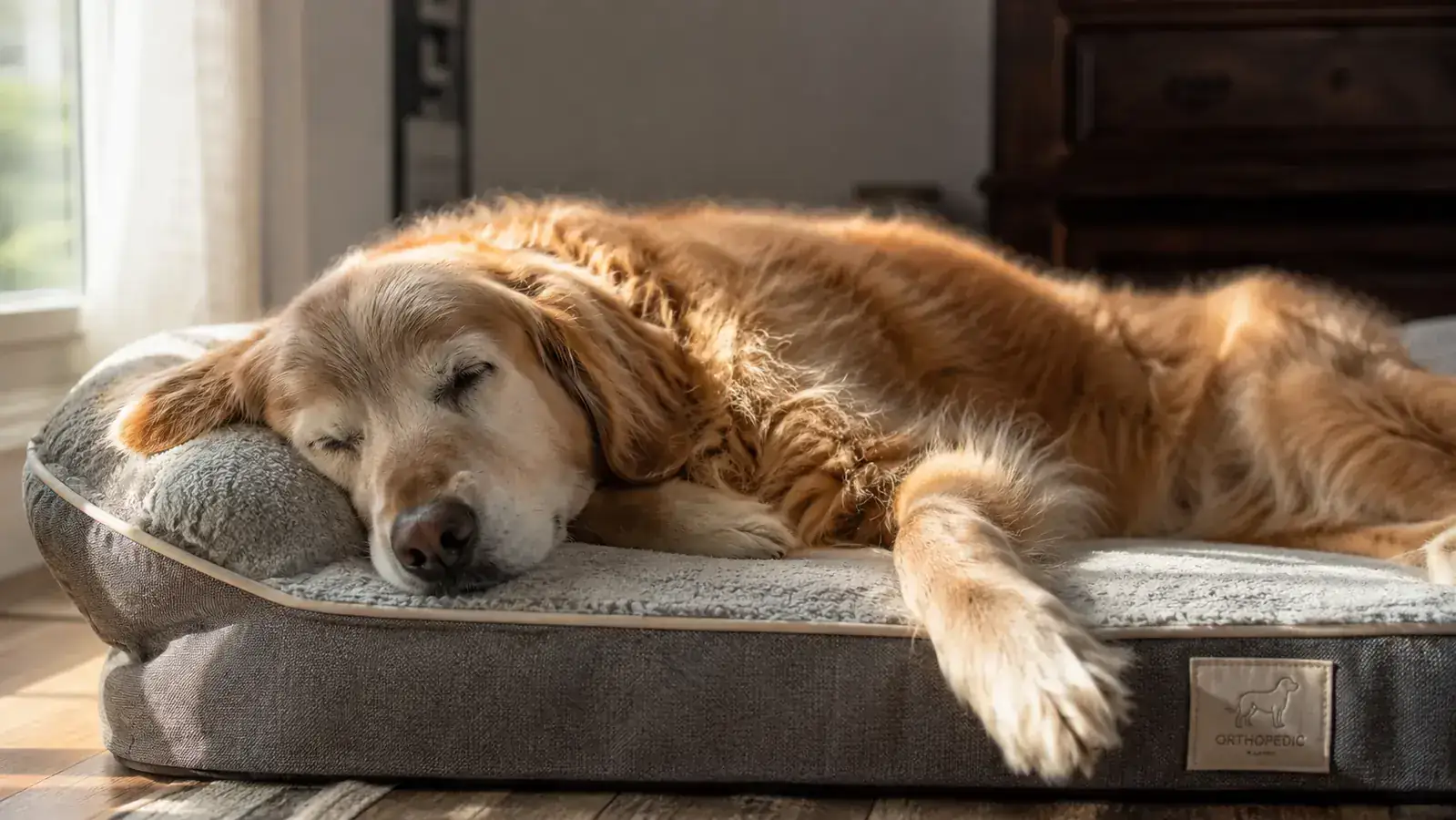
My dog Biscuit is eight years old, about 65 pounds, and built like a retired athlete who still thinks he can sprint. For most of his life I let him sleep on a folded-up moving blanket on the laundry room floor. It was clean, it was soft enough, and he never complained. Then I switched him to the Bedsure orthopedic memory foam bed and inside a week I noticed something I could not explain any other way: he stopped grumbling when he stood up in the morning. I had quietly accepted that stiffness as normal aging. It was not normal. It was just a bad bed.
If you have been treating a dog bed as a nice-to-have, this list is for you. These are the ten reasons a real orthopedic bed, one built on actual memory foam with enough density to matter, does more work than most pet owners realize, and why Biscuit will never sleep on a flat mat again.
Still running on a flat mat or a thin poly-fill cushion? Here is what that costs your dog every night.
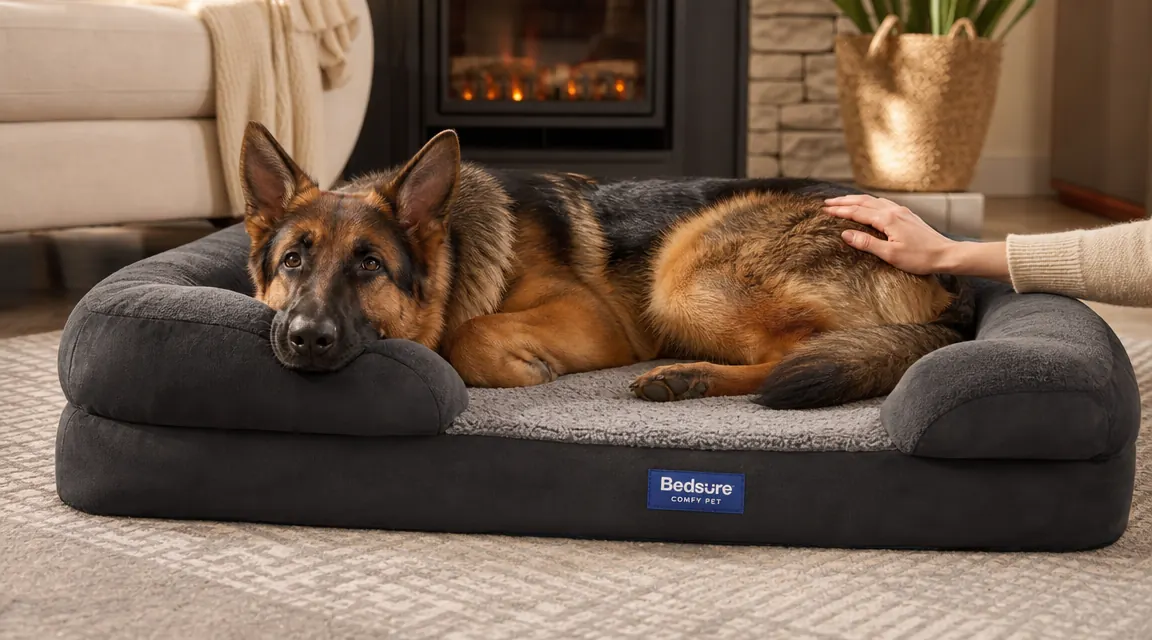
The Bedsure orthopedic dog bed uses egg-crate memory foam that conforms to your dog's shape, relieves joint pressure, and holds its structure through repeated washing. Over 51,000 Amazon reviews and counting.
Amazon Check Today's Price on Amazon →Memory Foam Distributes Weight Instead of Concentrating It
A flat mat or a thin cushion does not push back evenly. Your dog's heaviest points, shoulders, hips, elbows, sink through to whatever is underneath. Memory foam fills in around the body and spreads load across the full contact surface. That even distribution is the mechanical reason an orthopedic bed reduces soreness. It is not a marketing claim. It is basic physics applied to a dog who sleeps ten to fourteen hours a day.
Cold Floors Pull Heat Away From Joints All Night
Tile, hardwood, and concrete are thermal sinks. A dog lying directly on a cold floor loses body heat steadily through contact points, and muscle tissue around joints tightens in response to cold. A thick foam layer breaks that conduction. Biscuit used to migrate off his mat to the area rug by 3 a.m. The orthopedic bed fixed that. He stays put because the surface actually insulates.
Pressure Point Sores Start Long Before You See Them
Hygromas, the fluid-filled sacs that form over bony prominences like elbows, develop from repeated compression against hard surfaces. You often do not notice them until they are the size of a golf ball and already prone to infection. Vets see this most in large breeds sleeping on hard floors, but any dog spending hours on a thin surface is at risk. Foam thick enough to prevent bottoming-out removes the repetitive stress that causes them.
Young Dogs Build Sleep Habits That Determine Senior Comfort
This one surprised most of the dog owners I have talked to. We tend to think orthopedic gear is for old dogs. But a puppy who sleeps on a supportive surface develops muscle memory around low-stress rest postures. A puppy who sleeps jammed against a hard corner or on a mat that bottoms out learns to protect certain joints during sleep, and that compensation shows up as asymmetrical muscle development over time. Start with the right bed and you are investing in the joints your dog will rely on at age ten.
Post-Surgery and Post-Injury Recovery Depends on Surface Quality
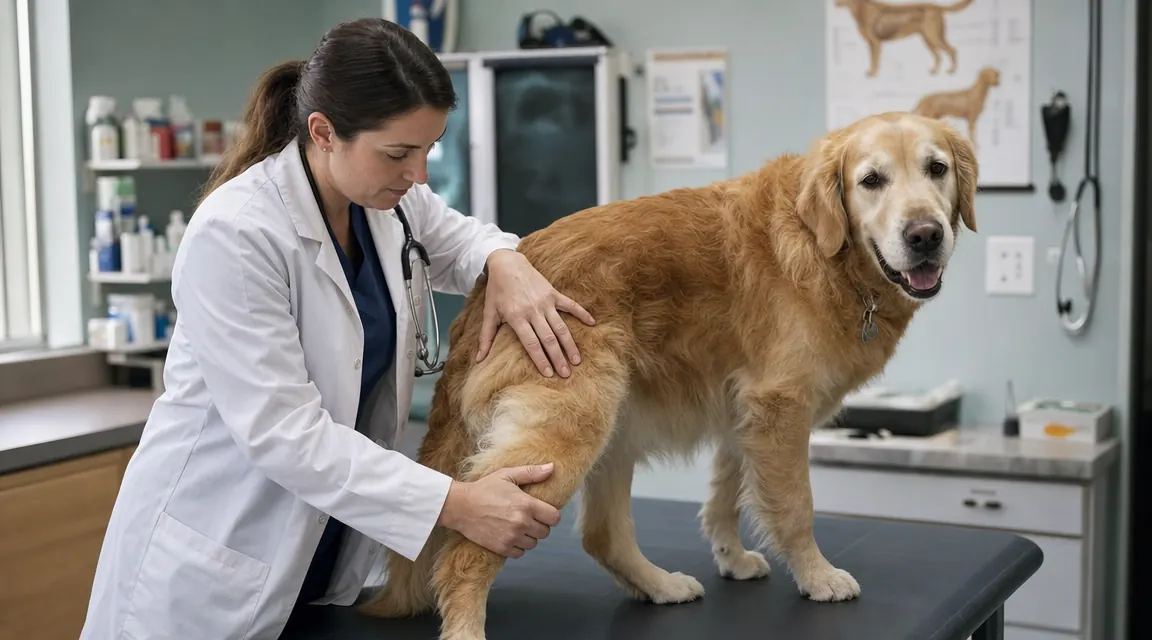
If your dog has ever had a TPLO, a hip replacement, or soft tissue repair, your vet almost certainly mentioned limiting hard-surface activity. What they are less likely to spell out is that sleeping surface matters as much as walking surface during recovery. A dog pushing itself up off a hard floor repeatedly during healing puts strain on the repair site. A firm but yielding foam surface reduces the push-up load and keeps the recovery environment consistent.
Deep Sleep Requires a Surface That Does Not Force Position Shifts
Dogs cycle through REM just as humans do, and the deepest restorative sleep happens when they can stay in one position without pain waking them. A dog that shifts constantly through the night is not sleeping well, it is managing discomfort. If your dog starts in one spot and wakes up in a completely different position every morning, the sleeping surface is worth examining. Biscuit went from a restless sleeper who repositioned every hour to a dog who stays put for four and five hour stretches.
Washable Covers Change the Hygiene Equation Entirely
This is the one that actually changes day-to-day life the most, and it is rarely the first thing people mention when recommending orthopedic beds. The Bedsure cover zips off and goes in the washing machine. If your dog has allergies, you need to wash bedding weekly. If your dog has a skin condition, you need to wash it more than that. Foam inserts that get wet and cannot dry properly grow bacteria inside. A waterproof inner liner on the foam plus a removable outer cover means you can keep the bed genuinely clean without replacing it every six months.
Anxiety and Stress Levels Track Directly With Rest Quality
A dog that is not sleeping well is running on a depleted nervous system. You see it as reactivity, as separation anxiety that seems worse on some days than others, as a dog that is harder to settle in the evening. Sleep quality and behavioral baseline are connected in dogs the same way they are in people. I am not saying a bed cures anxiety. I am saying that chronic poor sleep amplifies every other stressor, and a bed that eliminates physical discomfort removes one significant variable.
Bolstered Edges Give Dogs a Place to Rest Their Head and Neck
Dogs that curl up to sleep are supporting their own neck weight the whole time. A raised bolster along the back and sides of the bed gives them a surface to rest their chin or drape a neck across without muscle activation. This matters more than it sounds. Neck and shoulder tension in dogs tends to express as reluctance to look left or right quickly, as pain on lead changes, and as spinal stiffness. A bolster is not decoration. It is a pillow for an animal that cannot ask for one.
It Outlasts Cheap Beds by a Wide Margin When You Account for Foam Density
Most budget dog beds use polyester fiberfill that compresses to almost nothing within two months of regular use. You are essentially buying a flat mat with a soft cover. A dense memory foam orthopedic bed holds its loft. The Bedsure model I have had for Biscuit is nine months in and the foam still rebounds fully when I press on it. Over a two-year window, the per-month cost of a bed that does not need replacing every few months is lower than it looks on the product page.
What I'd Skip
Anything marketed as orthopedic that does not specify foam type or foam thickness is almost certainly fiberfill with a memory-foam-sounding name on the tag. I have returned three of those. If the product page does not show a cross-section of the foam layers and give you a thickness in inches, pass on it. I would also skip any bed without a waterproof liner on the foam insert itself. Covers get dirty and need washing. Foam that has absorbed urine or moisture, even once, does not fully recover and starts to hold odor regardless of how many times you wash the outer cover. The waterproof barrier between foam and cover is the detail that separates a bed you replace every year from one that lasts. My full breakdown of what to look for before buying is in the orthopedic bed buying guide for large breeds, and the four-month field report on the Bedsure specifically is in the Bedsure orthopedic dog bed review.
Biscuit had been grumbling every morning when he stood up. I had accepted it as aging. It was just a bad sleeping surface.
If any of these ten reasons landed, the Bedsure orthopedic bed is where I would start.
Memory foam core, waterproof inner liner, machine-washable cover, bolstered edges. The design checks every box on this list. Rated 4.5 stars across more than 51,000 reviews, with sizes running from medium up through extra large for dogs over 100 pounds.
Amazon Check Today's Price on Amazon →