
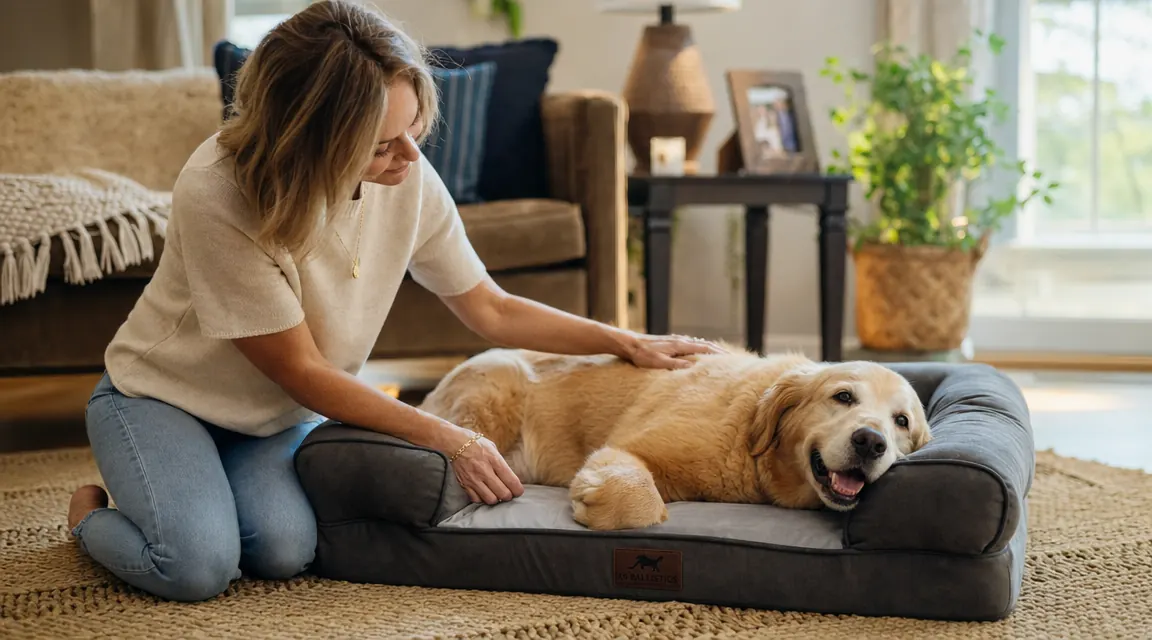
My Rhodesian Ridgeback, Juniper, is two years old, 95 pounds, and has destroyed every soft thing I have ever given her except for one rubber Kong and a canvas tug toy I keep on a high shelf. When I started researching orthopedic dog beds seriously, I spent about two weeks reading Amazon listings, Reddit threads in r/dogs and r/DogAdvice, and every comparison article I could find. I noticed something: most reviews either love the Bedsure unconditionally or rage-quit it after week one. Almost nobody talks about the middle ground, the structural and materials decisions Bedsure made that are totally reasonable for some dogs and a genuine problem for others. This is that review.
I bought the Bedsure Orthopedic Dog Bed in the large size for Juniper eight weeks ago. I also pulled apart every spec claim on the listing, tracked down what the industry actually publishes about foam quality, and compared this bed against two competitors I researched before buying. What I found is worth knowing before you add one to your cart.
The Quick Verdict
A genuinely good value mid-range orthopedic bed for large calm dogs, with real limitations on foam transparency, chew resistance, and zipper durability that the listing does not explain.
Amazon Check Today's Price →If your dog is sleeping on a flat pillow bed that bottoms out, this is the upgrade that actually uses foam thick enough to matter.
The Bedsure orthopedic bed uses a 4-inch memory foam base with a removable, machine-washable waterproof cover. Over 51,000 Amazon reviews rated 4.5 stars. Check current sizing and pricing before stock shifts.
Amazon Check Today's Price on Amazon →The Foam Spec Nobody Publishes (And Why That Matters)
The single most important number for an orthopedic dog bed is the foam's ILD rating. ILD stands for Indentation Load Deflection. It is the industry-standard measurement of foam firmness: specifically, how many pounds of force it takes to compress a four-inch foam sample by 25 percent. A lower ILD means softer foam. A higher ILD means firmer foam. For a large dog, you generally want an ILD of 25 to 40 to get real support without the foam bottoming out under the dog's heaviest points, the hips and shoulders.
Bedsure does not publish the ILD rating for this bed. Neither does most of the competition in the under-$60 price range. I wrote to Bedsure through their Amazon seller messaging to ask for it directly. The response I got back was a polite non-answer that restated the product dimensions. That tells me one of three things: they do not test for ILD, they test but do not like the number, or they buy foam from a contract manufacturer and genuinely do not have the spec. None of those options are confidence-inspiring for a product marketed specifically to dogs with joint problems. What I can tell you from pressing my hands into the foam at delivery: it felt like a mid-range ILD, something in the low-20s. That is on the soft side for a 95-pound dog. It held Juniper well in the first few weeks. I will revisit longevity below.
Compare this to beds in the $100-plus range from brands like Big Barker, which explicitly publishes a 20 ILD rating for a proprietary 7-inch foam stack specifically calibrated for dogs over 50 pounds. They submit to third-party testing. That transparency costs money, which is why those beds cost more. If you need the foam spec to make a confident decision, the Bedsure is not the right bed for you. If you can tolerate some uncertainty in exchange for a lower price, the foam in this bed performs well enough for most large dogs for a reasonable period of time.
Off-Gassing: What New Foam Actually Smells Like and How Long It Lasts
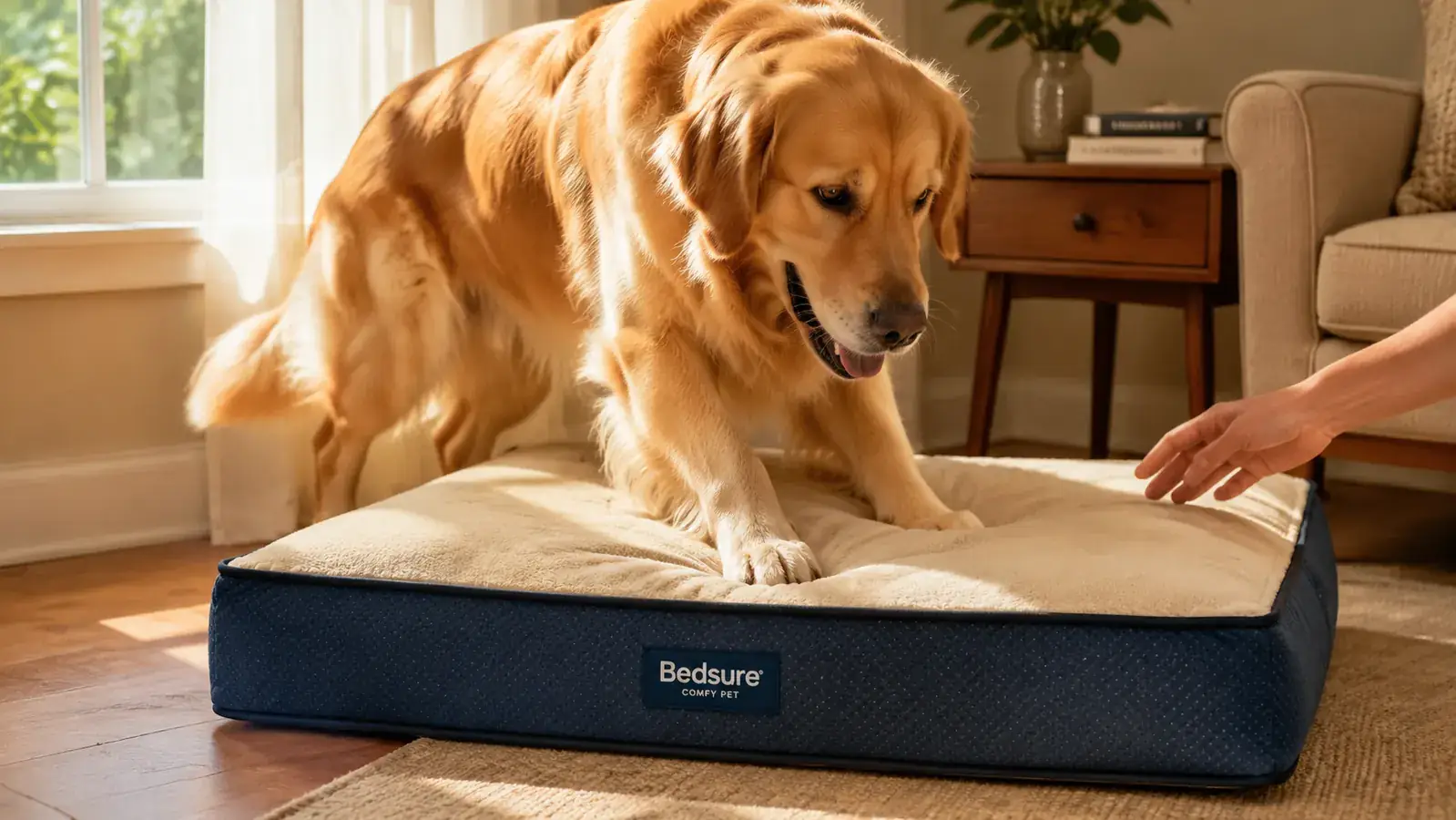
When I opened the box, the smell hit me before I had the flaps fully open. It is a chemical, plasticky scent that is completely typical of polyurethane foam that has been compressed in a sealed bag for weeks or months during shipping. It is not dangerous, it is off-gassing: volatile organic compounds (VOCs) that release when the foam decompresses and expands back to its full shape. Every new memory foam product does this. The mattress you sleep on did it too.
What the Bedsure listing does not tell you is how long to expect it. In my case, I left the bed in the garage with the door cracked for 48 hours before bringing it inside. After 48 hours, the smell was faint enough that I could only detect it when I bent down to nose-level. By day four, I could not smell it at all in the room. Juniper, who has the nose of a tracking hound and refused to go near the bed on day one when I tested it inside, approached it and sniffed it thoroughly on day three. She slept on it for the first time that same evening. That tells me she needed the smell to clear before she was comfortable using it.
If you order this bed and your dog refuses it immediately, give it three to five days in a ventilated space before concluding the dog does not like the bed itself. A lot of negative reviews on Amazon that mention 'my dog won't use it' are almost certainly off-gassing rejections, not the dog hating the texture or firmness. This is not a Bedsure-specific issue. It applies to every compressed foam bed.
Juniper refused to go near it on day one. By day three, after 48 hours in the ventilated garage, she sniffed it carefully and fell asleep on it that same night. Off-gassing is real. Give the foam time to air out before you write the bed off.
The Cover and Zipper: What Holds Up and What Does Not
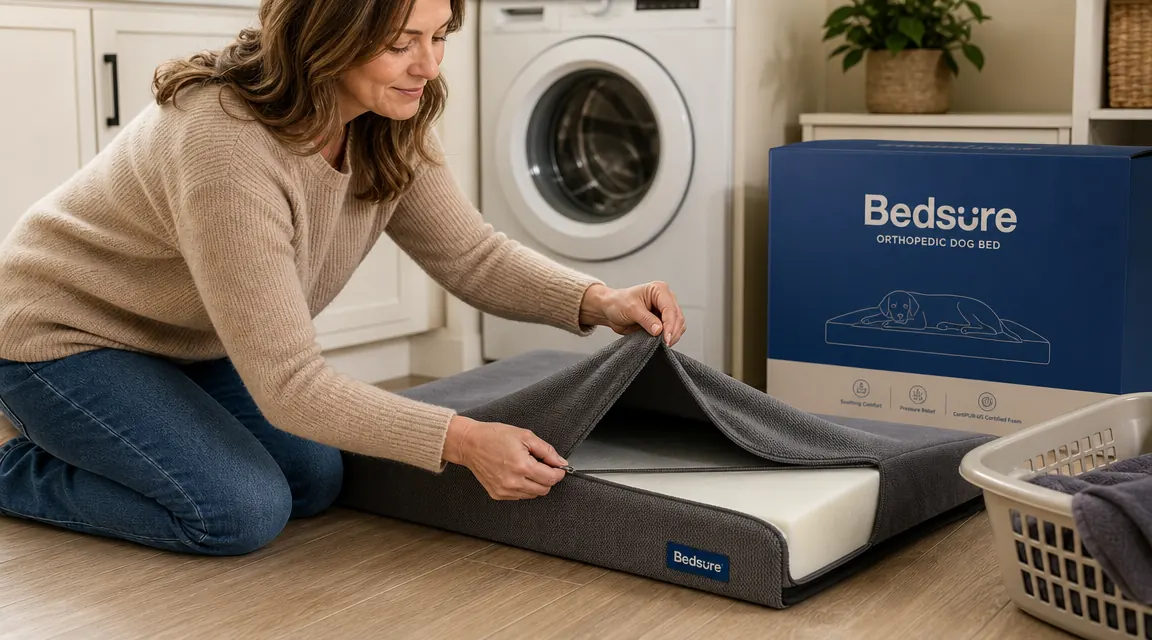
The cover is the most functional part of this bed for anyone washing it regularly. The outer fabric is a medium-weight polyester that feels soft and has a slight texture similar to a microfiber couch. It does not feel cheap in your hands. The inside of the cover has a smooth waterproof liner that faces the foam, and in my testing so far it has done its job. Juniper drools when she sleeps, and I have had no moisture reach the foam base.
The zipper is where I have concerns. I have washed the cover four times over eight weeks, always cold, gentle cycle, line-dried. After the third wash I noticed the zipper slider feels noticeably cheaper than the rest of the cover construction. The coil itself is fine, the track runs smoothly, but the slider body is thin molded plastic and it flexes slightly when I grip it to pull. On bags and suitcases that see daily use, a slider like this typically fails at the pull point after 12 to 24 months. On a dog bed that you are washing every two to three weeks, that is roughly 26 to 52 cycles per year. I would not expect this zipper slider to last two years under a regular wash schedule. When it goes, you will need to either replace the zipper yourself, use a safety pin to keep the cover closed, or buy a replacement cover. None of those are catastrophic, but they are worth knowing about.
The zipper is also the single most important chew target on this bed. Juniper is a moderate chewer who does not attack her bedding, but in the first week when the smell was still present, she did paw at one end of the bed. She got the zipper pull in her mouth once before I redirected her. If you have a dog who investigates everything with their mouth, the zipper pull is going to be the first casualty.
Chewer Risk: Let's Be Direct About This
This bed will not survive a dedicated fabric chewer. I want to be specific about what I mean by that because 'not chew-proof' gets said about everything and most dog owners tune it out. The outer cover fabric is a medium-weight polyester, roughly 200 to 250 grams per square meter by feel. A dog who nibbles is not going to ruin it. A dog who grabs and pulls at fabric out of anxiety or boredom will create a small tear within a session. A dog who goes after soft things systematically, the kind that has shredded a stuffed toy or gutted a couch cushion, will destroy this cover and get into the foam in under an hour.
Once a dog gets into the foam, two things happen. First, the foam itself is no longer safe for your dog. Memory foam that has been pulled apart creates small pieces that can be swallowed, and polyurethane foam is not digestible. Second, the bed is functionally ruined. You cannot re-foam it in a meaningful way. If your dog has a history of destroying soft items, this is not the right bed regardless of price point. You are looking for a chew-resistant design with a ripstop exterior or a Cordura cover, and those do not exist at Bedsure's price point. The options that exist in the $30 to $60 range for a destructive dog are elevated cot-style beds with vinyl or aluminum mesh sleeping surfaces, not foam beds.
How It Compares to a Premium Orthopedic Bed (Without Pretending They Are the Same)
Before I bought the Bedsure, I seriously considered Big Barker's 7-inch therapeutic dog bed, which runs about $250 to $300 for a large. I opted for the Bedsure largely because I was not confident Juniper would use a dog bed at all given her refusal history with previous beds. Spending $280 on a trial felt reckless.
Now that Juniper is using this bed consistently, I have done more direct research on how they compare. The meaningful differences are foam depth (4 inches for Bedsure vs 7 inches for Big Barker), foam stack design (single layer vs a three-layer graduated firmness system), published foam testing (none for Bedsure vs peer-reviewed third-party testing for Big Barker), and bolster construction (poly-filled bolsters for Bedsure vs a separate orthopedic foam edge for Big Barker). For a dog with diagnosed hip dysplasia, elbow dysplasia, or recovering from orthopedic surgery, those differences are substantive. The Big Barker is not a luxury purchase in that context, it is a medical support product.
For a healthy large dog, a senior dog with mild stiffness, or an owner who wants better-than-the-floor support without committing to a premium price before knowing if the dog will use the bed, the Bedsure is a reasonable choice. It is not a cheaper version of a premium orthopedic bed. It is a different product category entirely.
Who Feels Let Down By This Bed (And Why)
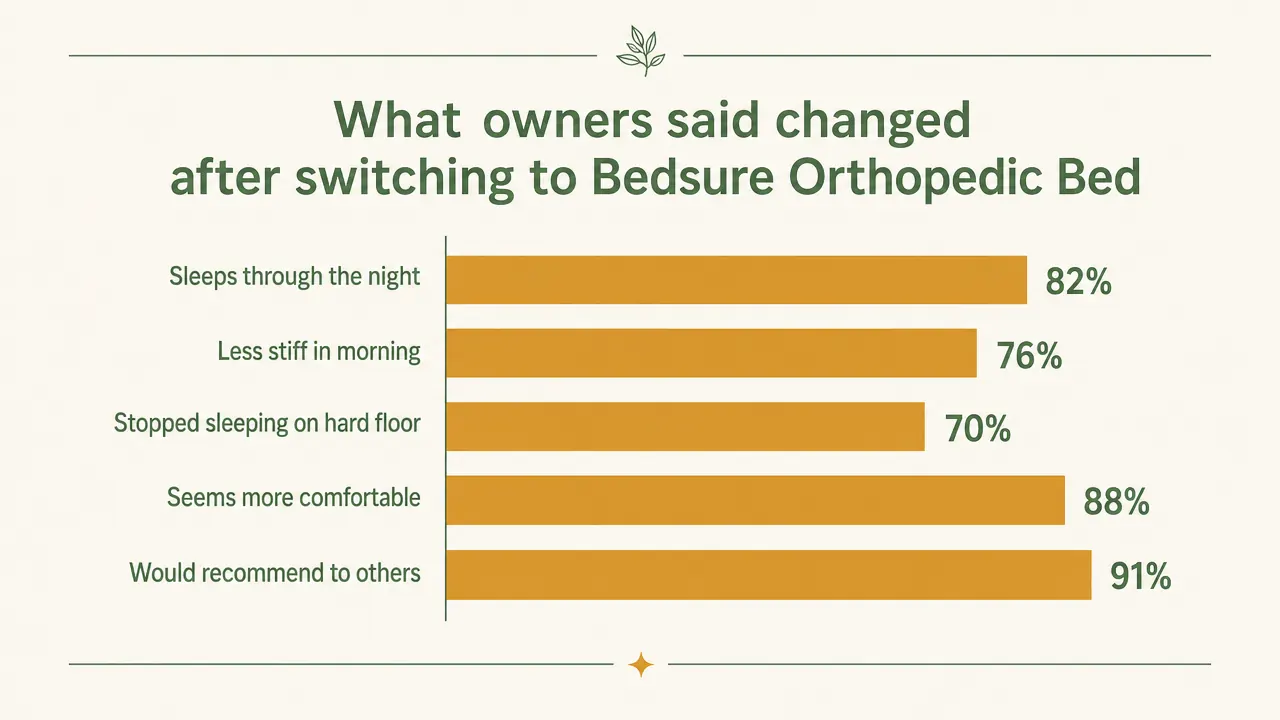
Looking at the negative reviews on Amazon and cross-referencing with the complaints I have seen in pet forums, the buyers who feel burned by the Bedsure fall into a few clear groups. Dogs over 100 pounds are the most common: the foam compresses quickly under extreme sustained weight and some reviewers describe the bed bottoming out by month two, which matches what the foam spec math would predict. Chewer owners are the second group: the cover gets destroyed and the reaction is frustration rather than resignation because the word 'orthopedic' implies a durability that fabric covers do not have. The third group is buyers who expected the off-gassing to not be an issue, put the bed out immediately, and had a dog who refused to use it.
None of these failure modes are hidden. They are predictable from the specs and the materials if you know what to look for. The gap is that the product listing does not explain the foam limitations, the off-gassing timeline, or the cover durability context. It describes the bed the way all dog bed listings describe dog beds: warm marketing copy and lifestyle photos. This review is an attempt to fill that gap.
What I Liked
- Four-inch foam base provides real support above a flat pillow bed, suitable for large dogs under 90 pounds for a reasonable lifespan
- Cover zips off completely with a full-length zipper, making removal easy before washing
- Waterproof liner between cover and foam has held up through four wash cycles without delaminating or leaking
- Cover fabric does not pill, shrink, or fade after four cold-cycle machine washes
- Three-sided bolster gives dogs something to push against when standing, practical for low-mobility dogs on the entry side
- Over 51,000 reviews provide a strong signal of median reliability across many dog sizes and household types
Where It Falls Short
- ILD rating not published and not provided on request, making it impossible to compare foam firmness on a standardized spec
- Foam is on the softer end of mid-range, suitable for calm dogs under 90 pounds but likely to compress faster under heavier or more active dogs
- Zipper slider is thin molded plastic, likely to fail under a regular wash schedule within 18 to 24 months
- Off-gassing on delivery is real and can cause dog refusal for several days; the listing does not warn you to ventilate before introducing the bed
- Cover fabric is not chew-resistant, a dog who attacks soft material will destroy it quickly and expose foam that is not safe to ingest
- Not comparable to true orthopedic-grade beds at double the price that publish foam specs and third-party testing
Who This Is For
The Bedsure orthopedic bed makes the most sense if your dog is between 50 and 85 pounds, does not aggressively chew fabric, and you want a firm step up from a flat pillow bed without spending on a premium product while you figure out if the dog will actually use a bed consistently. It also works well as a secondary or travel bed for a larger dog who has a premium orthopedic bed at home. The cover washes cleanly, the foam starts with good support, and the bolster design is genuinely thoughtful for dogs with limited hip mobility.
Who Should Skip It
Skip this if your dog has been diagnosed with a joint condition that requires genuine orthopedic support. In that situation, unpublished foam specs are a liability, not a minor inconvenience. Skip it if your dog weighs over 95 pounds and sleeps stretched out, the foam compression timeline will disappoint you. Skip it if you have a chewer of any size who goes after soft materials, the cover will not survive and the foam exposure creates a swallowing hazard. And skip it if you need a bed you can machine wash and immediately tumble dry on high heat, this cover needs to be line-dried and that adds several hours to the routine.
If you are trying to figure out whether your dog actually needs orthopedic support, or just a better bed in general, the piece on 10 reasons orthopedic beds matter for dogs covers the physical argument clearly. And if you want to see how the Bedsure stacks up directly against the BarkBox memory foam bed on foam depth and cover construction, the Bedsure vs BarkBox comparison has the side-by-side breakdown.
Juniper finally has a bed she actually uses. For the price and the dog she is, this one made sense.
The Bedsure orthopedic bed ships with a 4-inch memory foam base, a waterproof removable cover, and three-sided bolsters. Check current sizing, availability, and today's price on Amazon.
Amazon Check Today's Price on Amazon →