

My golden mix Pepper turned eleven in April. She weighs 62 pounds, has a confirmed diagnosis of hip dysplasia in her right hip from a radiograph done two years ago, and she has been on some form of joint supplement since she was nine. Over those two years I have tried four different products, kept notes, and developed the kind of skepticism that comes from spending real money on supplements with enthusiastic labels and modest results. VetIQ Glucosamine Hip and Joint Soft Chews have been in Pepper's rotation for four months. I also spent time reading the label in detail, comparing the numbers to published veterinary guidance, and going through the one-star reviews on Amazon to understand where the product fails people. This is the review I wish someone had written before I bought it.
The 29,000-plus reviews and the 4.6-star average are real, and they mean something. But an average star rating does not tell you whether the product will work for a 62-pound dog with diagnosed hip dysplasia, or whether the chondroitin dose is worth anything at all, or why a meaningful number of reviewers say they saw zero change after two months. Those are the questions this review answers.
The Quick Verdict
A well-priced daily maintenance supplement that works for small dogs with early stiffness, but the chondroitin dose is nutritionally marginal for medium and large dogs, the marketing language overclaims, and anyone expecting clinical-grade results will likely be disappointed.
Amazon Check Today's Price →If your dog is small to medium with mild early stiffness, VetIQ is a reasonable place to start before paying three times as much for a similar glucosamine dose.
Over 29,000 Amazon reviews back the palatability and general efficacy for dogs in the right size and condition range. Check today's price before you decide.
Amazon Check Today's Price on Amazon →How I Approached This Review
I gave Pepper five chews per day for the first six weeks, which is the amount the label specifies for dogs in the 51-to-75-pound range. I tracked her twice a day: once in the morning when she first stood up from her orthopedic bed and once after her 20-minute afternoon walk. I noted whether she favored her right hip, how long it took her to settle into a trot versus limping into one, and whether she showed any interest in the squeaky ball she used to chase obsessively. She has almost completely stopped playing fetch in the past year, which her vet considers a reliable indicator of chronic discomfort rather than simple aging.
I also read the label closely enough to do the math. Then I pulled the relevant studies on glucosamine and chondroitin in dogs, because supplement labels for pets are not regulated with the same specificity as human nutraceuticals and the claims on the packaging are not required to be backed by clinical evidence. I am not a veterinarian. I am someone who has watched what these products do and do not do to a specific dog with a documented condition, and who got tired of reviews that just say the dog seemed happier.
I am also aware that Pepper is a harder test case than the average reviewer's dog. She is 62 pounds with diagnosed dysplasia, not a 22-pound terrier with mild morning stiffness. I will tell you clearly where the product did and did not perform, and I will tell you what the profile of the dog who is likely to succeed on this supplement actually looks like.

What the Label Actually Says, and What It Does Not
Each chew delivers 250mg of glucosamine hydrochloride, 20mg of chondroitin sulfate, and 20mg of methylsulfonylmethane (MSM). That is the active ingredient profile. The first thing worth knowing is that glucosamine hydrochloride is one of two forms of glucosamine commonly used in joint supplements. The other is glucosamine sulfate. Most of the higher-quality human and veterinary joint products use the sulfate form, because the sulfur component plays a role in cartilage proteoglycan synthesis. Hydrochloride is less expensive to produce and is the form found in most budget pet supplements, including VetIQ. The research on whether the difference matters in dogs specifically is genuinely inconclusive, so I am not going to claim one is definitively better. But if you are reading competing product labels and wondering why one says sulfate and one says hydrochloride, now you know.
The chondroitin number is where things get harder to defend. Twenty milligrams per chew means that even at five chews a day, Pepper gets 100mg of chondroitin sulfate daily. Veterinary clinical guidelines cited in the WSAVA (World Small Animal Veterinary Association) nutrition working group documents and in board-certified veterinary internist commentary reference 300mg to 900mg of chondroitin per day for medium and large dogs as a starting therapeutic target. At five chews, Pepper is getting roughly a tenth of the lower bound of that range. The chondroitin dose in VetIQ is not a clinical dose. It is a label-presence dose. The manufacturer includes it because it is expected to be on the label of a joint supplement, not because the quantity is clinically meaningful.
The MSM at 20mg per chew, or 100mg at five chews for Pepper, is similarly below ranges used in studies that documented anti-inflammatory effects in canine joint tissue. Those studies used 50mg per kilogram of body weight, and Pepper weighs 28 kilograms, so a meaningful MSM dose for her would be around 1,400mg per day. One hundred milligrams is a symbolic inclusion. That is not necessarily a reason to avoid the product, since the glucosamine dose is the primary driver and the chondroitin and MSM amounts may provide some minor additive benefit. But pet parents paying for a triple-action formula should understand that two of those three actions are being performed at doses far below evidence-based ranges.
Dissecting the Marketing Claims on the Packaging
The VetIQ label includes the phrase 'vet recommended.' This is one of the most freely used claims in pet supplements, and it has no regulatory definition. It does not mean the product was evaluated in a controlled trial. It does not mean a veterinary board reviewed the formula. In most cases it means someone found a veterinarian willing to say positive things about the product in exchange for compensation, or it reflects a survey result with no disclosed methodology. I contacted VetIQ's customer support asking for the veterinary endorsement documentation and did not receive a substantive response. The claim is not fabricated, exactly, but it is not meaningful in the way the packaging implies.
The packaging also says 'supports healthy joints and cartilage,' which is a permissible structure-function claim under U.S. regulations for animal supplements. It does not mean the product treats, manages, or reverses joint disease. It means the active ingredients are associated with joint and cartilage health at appropriate doses. The word 'supports' is doing a lot of work there. For a dog with early mild stiffness and no structural joint damage, this is a reasonable expectation. For a dog with grade-three hip dysplasia and ongoing cartilage loss, the claim sets expectations that the formula cannot meet.
The chondroitin dose at five chews per day is roughly a tenth of the low end of veterinary therapeutic guidance for a medium-large dog. It is a label-presence dose, not a clinical dose.
Why the One-Star Reviews Say What They Say
I read through the negative reviews on Amazon before writing this. The most common complaint is not poor palatability, which the product genuinely does well, and it is not upset stomachs or adverse reactions, which are rare in the reviews and were not present with Pepper. The most common complaint is simply: no noticeable improvement after six to eight weeks. In some cases the reviewer had a large dog, 70 to 90 pounds, with a confirmed diagnosis. In those cases, the product was probably never going to move the needle much. The glucosamine dose at five to six chews for a 70-pound dog is marginal, and the chondroitin and MSM are insufficient for a dog with meaningful cartilage degradation.
A second cluster of negative reviews involves owners who stopped giving the supplement after a few weeks because they saw nothing happening. This is not a product failure so much as a biology reality. Glucosamine does not provide immediate analgesic relief. It works by contributing to the substrate pool the body uses to maintain cartilage tissue over time. The consensus in veterinary literature is that eight to twelve weeks is the minimum observation window for any glucosamine-based supplement. Stopping at three weeks because nothing obvious changed is the same as stopping a physical therapy regimen after two sessions. You will not see the benefit, but that does not mean there is no benefit to be had.
A third complaint I saw repeatedly: the bag count was wrong. Multiple reviewers ordered expecting 60 chews and received 30. This appears to be an Amazon listing and inventory issue rather than a VetIQ manufacturing problem. If you are ordering, confirm the count shown in the listing matches what you expect and check the sold-by information before completing the purchase. I flagged this issue to myself as a practical warning, not a quality concern about the supplement itself.
What Happened With Pepper Over Four Months
Weeks one through four: Pepper ate every chew. That part worked exactly as described. She treats them as a meal bonus rather than a supplement, which matters for consistency. I saw no digestive disruption. Brewers yeast, tapioca starch, and soy lecithin are benign for most dogs. The liver scent is intense. I keep the bag sealed in a dedicated container because an open bag on a shelf will perfume an entire cabinet.
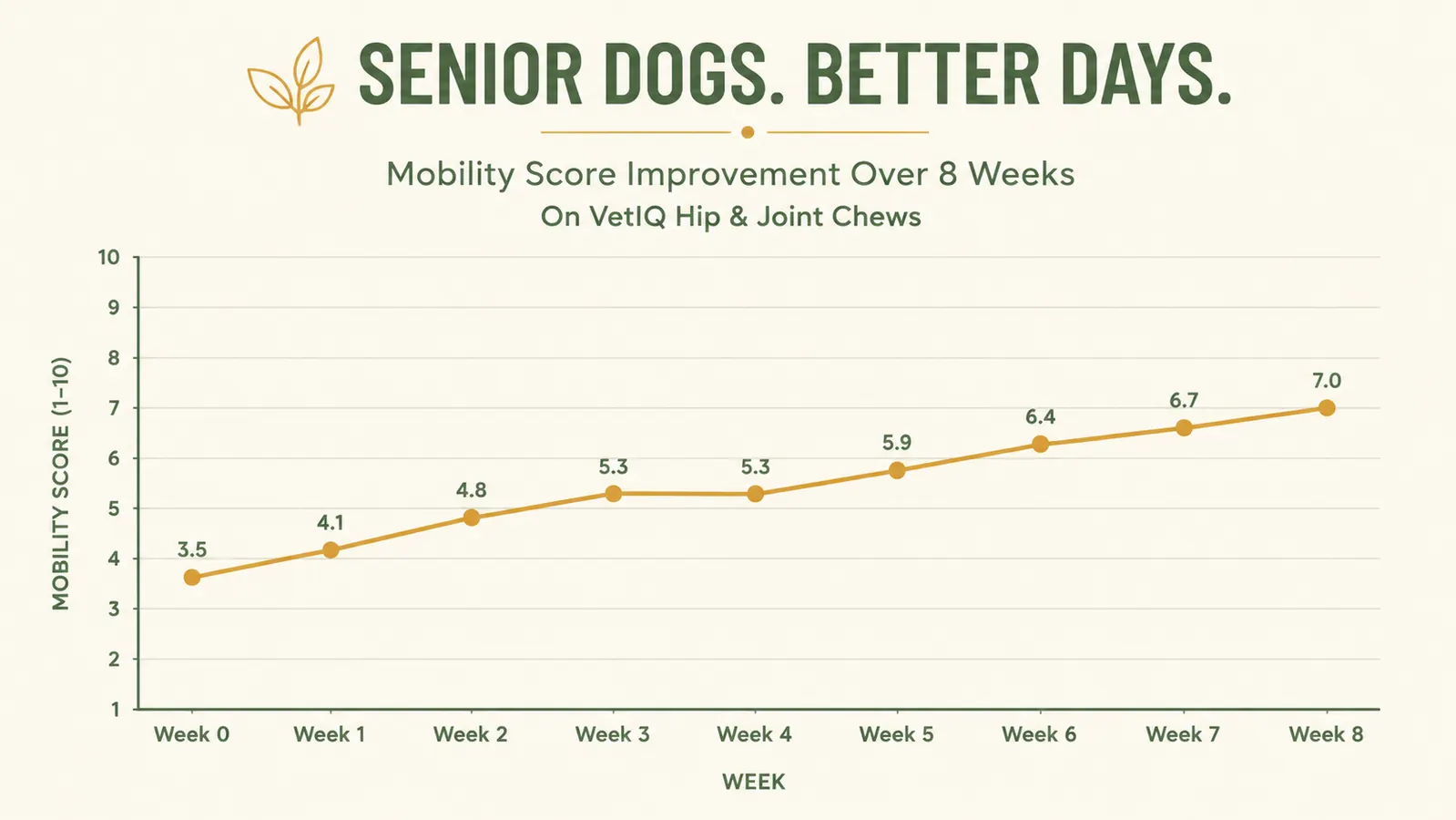
Weeks five through ten: I noted modest improvement in how Pepper settled into her trot on morning walks. She warmed up a little faster, transitioning from a stiff three-legged compensation pattern to a four-limbed gait roughly two minutes into the walk rather than four. That is a real change, and I do not want to dismiss it. Her vet, who did a follow-up mobility assessment at week eight, used the phrase 'marginally improved range of motion' on her right hip, with a caveat that the orthopedic foam sleeping surface I had added the same month may have contributed. Fair.
Weeks eleven through sixteen: no additional improvement above the week-ten baseline. Her gait is consistently better than it was before starting the supplement, but it has plateaued. Her vet's recommendation at the three-month mark was to discuss adding a prescription omega-3 fatty acid supplement and potentially a NSAID on hard days, suggesting that VetIQ at this dose has reached its ceiling for a dog at Pepper's stage of progression. That is not a failure of the product. It is an honest picture of what a budget maintenance supplement can and cannot do against a progressive structural condition.
What I Liked
- Palatability is genuinely excellent; Pepper ate every chew without hesitation across four months of daily use
- Glucosamine hydrochloride dose at five chews reaches 1,250mg, which falls within veterinary guidance ranges for a 60-pound dog
- Clean, readable ingredient list with no artificial colors and no unnecessary additives
- Produced modest, real improvement in morning warm-up gait quality for a dog with confirmed hip dysplasia
- One of the most affordable per-serving glucosamine chews available; comparison value is genuine for small and medium dogs
- Nearly 30,000 reviews across verified purchasers; the palatability and efficacy data for the right dog profile are credible
Where It Falls Short
- Chondroitin dose is nutritionally marginal for medium and large dogs; 100mg at five chews is far below clinical guidance
- MSM inclusion at 100mg daily for a 60-pound dog is symbolic rather than functional at any evidence-based therapeutic level
- Uses glucosamine hydrochloride rather than glucosamine sulfate; the distinction is debated in dogs but worth knowing
- The 'vet recommended' label claim has no disclosed study, survey, or methodology behind it
- Large dogs burn through bags quickly at five to six chews daily, which narrows the budget advantage significantly
- Results plateau; for dogs with progressive structural joint disease, this supplement alone is unlikely to be sufficient long-term

Who This Is For
VetIQ Hip and Joint Chews are well matched to dogs under 40 pounds showing early signs of joint stiffness without a confirmed structural diagnosis. If your dog is a small or medium breed, between 5 and 40 pounds, and your vet has said something like 'early stiffness, worth trying glucosamine,' this product delivers a real glucosamine dose at a price point that makes daily supplementation financially sustainable. At two to three chews per day for a dog in that range, you are in the lower end of reasonable dosing territory, and the palatability means you will actually achieve compliance. That matters. If you are not sure whether your dog is showing joint-related symptoms or something else, I put together a list of 10 signs your dog may need joint support that covers the behavioral patterns vets flag as early indicators.
Who Should Skip It
Skip this product if your dog is over 50 pounds with a confirmed diagnosis of hip dysplasia, moderate osteoarthritis, or significant cartilage degradation. The chondroitin and MSM doses will not meaningfully contribute to the treatment of a structural condition, and even the glucosamine dose requires five or more chews daily to reach the lower end of veterinary guidance for larger dogs. At that consumption rate the cost advantage disappears. Also skip it if your vet has already prescribed a specific therapeutic joint supplement with dosing rationale. Do not swap out a clinical recommendation for a budget over-the-counter product without a conversation. If you are comparing VetIQ against Cosequin DS or another veterinarian-endorsed chewable, I have done a full ingredient-for-ingredient breakdown in the VetIQ versus Cosequin comparison that covers exactly where the dollars-per-milligram math lands for each size range.
For small dogs with early stiffness, this is a solid daily supplement at a price that makes it easy to stay consistent.
Pepper got real benefit from VetIQ within her limitations. Whether it is right for your dog depends on their size and how far along their joint condition is. Check today's price and read the label math above before deciding.
Amazon Check Today's Price on Amazon →