
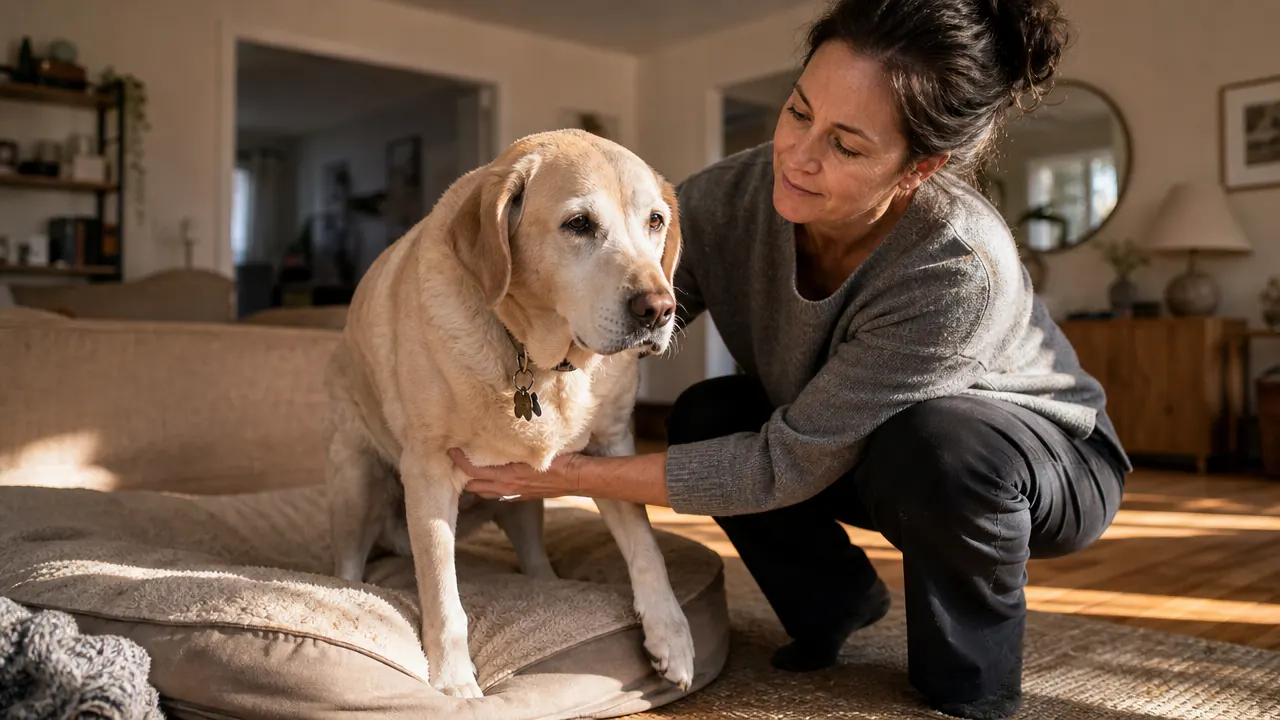
My beagle, Pepper, is nine years old and about 26 pounds. For the past year and a half she has been stiff after sleeping, slow to stand up from her bed, and reluctant to hop onto the couch the way she used to. The vet confirmed what I suspected: mild hip joint degeneration, common in older dogs, not urgent enough for prescription medication yet, but worth managing daily. What my vet gave me was a list of lifestyle adjustments, not a prescription. That list, refined over eighteen months of trial and error, is what I want to share here. None of it requires a vet visit every month. Most of it is free or costs under twenty dollars to start.
Joint stiffness in dogs is not always a one-fix problem. If you have been waiting for a single supplement or one vet visit to solve it, you will be disappointed. What actually works is a consistent routine that addresses movement, warmth, sleep surface, supplementation, and weight, all working together. The good news is that none of these steps are complicated once you know what you are doing and why each one matters.
The Supplement I Use in This Routine Every Morning
VetIQ Glucosamine Hip and Joint Soft Chews are the easiest part of this routine to stay consistent with. Pepper treats them like a snack. Each chew combines glucosamine with MSM and vitamin E. Over 29,000 Amazon reviews at a 4.6-star rating. Check today's price before you read further if you want to start here.
Amazon Check Today's Price on Amazon →Step 1: Start Every Morning With a Short Warm-Up Walk
Before Pepper gets breakfast, she gets a five-minute walk. Not a real exercise walk, just a gentle, unhurried circuit around the block at her pace. The goal is to get synovial fluid moving through the joint before she has to bear full weight on stairs or jump for her bowl. Think of it as warming up a cold engine before you push it hard. It sounds almost too simple to be worth doing, but it is the single most consistent change I made in Pepper's routine and the one that showed up fastest.
Stiff joints are stiffest right after rest. The synovial fluid that lubricates the joint becomes more viscous when the joint is still for hours, the same way cooking oil thickens in a cold kitchen. Gentle movement redistributes it. Pepper went from three-legged hobbling to a near-normal gait within about a week of this becoming a non-negotiable morning habit. I used to feel guilty dragging her outside before coffee. Now I see her waiting by the door.
Keep the walk slow and flat. Hills and uneven terrain create more compressive force on already-inflamed joints. If it is raining or cold outside, even five minutes of slow indoor walking up and down a hallway does the job. The point is low-impact movement before any higher-stress activity, not cardio output. You can build the longer walks in later in the day once the joint has warmed up.
Step 2: Add a Glucosamine Supplement to the Daily Routine
Glucosamine is the most-studied joint supplement for dogs and the most recommended by veterinarians as a first-line tool before pharmaceutical anti-inflammatories become necessary. It does not work overnight. The research on glucosamine in dogs generally points to a four-to-eight-week build-up period before you see meaningful changes in mobility and comfort. If you tried it for two weeks and gave up, that is why. You have to commit to the full window before making a judgment call.
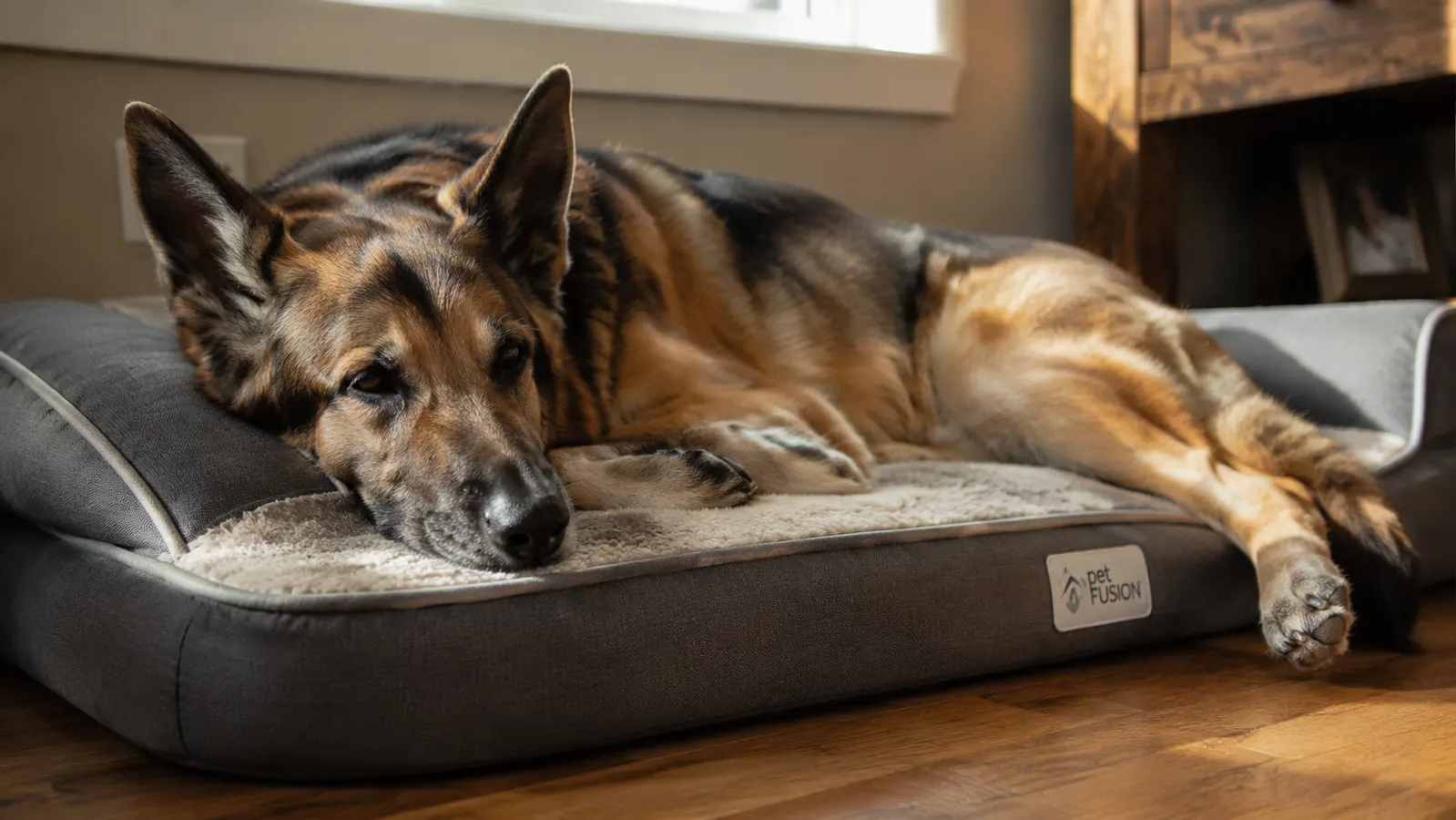
I use VetIQ Glucosamine Hip and Joint Soft Chews for Pepper. Each chew delivers 400 mg of glucosamine hydrochloride paired with MSM, which has its own anti-inflammatory properties, and vitamin E as an antioxidant. The soft-chew format matters more than it sounds: hard tablets are easier to skip or spit out, especially in a stubborn beagle. Pepper eats these voluntarily, which means I actually give them to her every single day, which is the only way they work. Consistency over the full six-to-eight-week ramp is what moves the needle.
The product has over 29,000 reviews on Amazon and a 4.6-star rating. That kind of review volume for a pet supplement is unusual and worth noting. Most competing products in this price range have a fraction of that feedback. The price is consistently low and the bag lasts two months on a single chew per day for a small dog. For the full ingredient and dosage breakdown, see my VetIQ Hip and Joint Chews review.
Step 3: Move the Sleeping Surface Off the Cold Floor
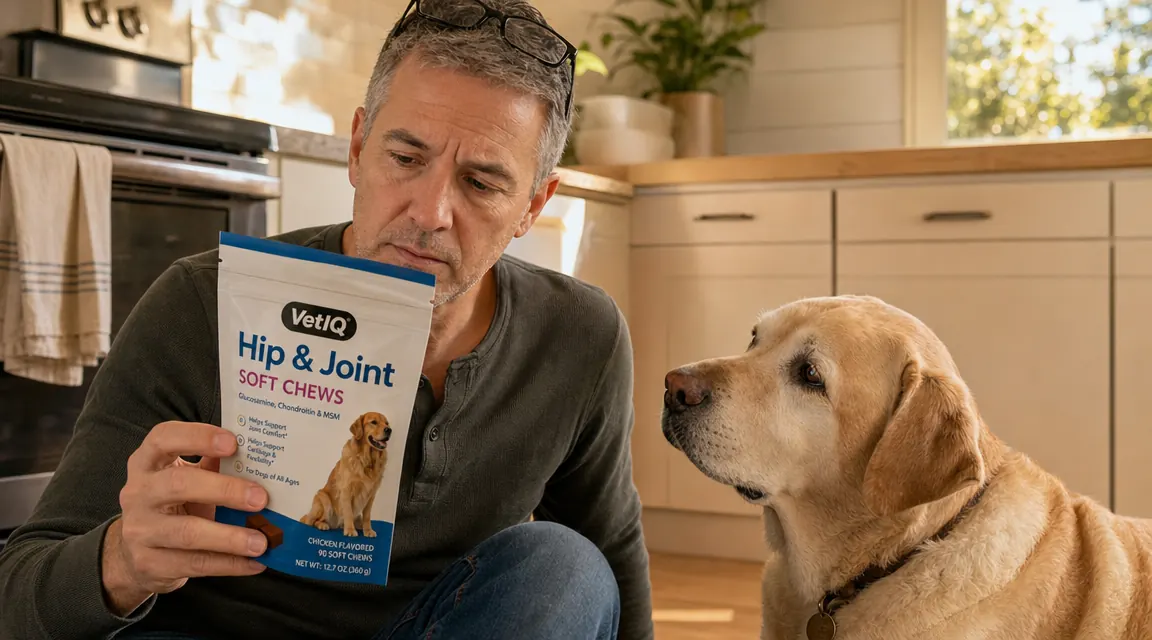
Cold and hard surfaces are the enemy of joint stiffness. Tile, hardwood, and even low-pile carpet pull warmth away from a dog's joints while they sleep, which makes that first-morning stiffness significantly worse. If your dog sleeps on the floor and wakes up struggling to stand, the floor is contributing to the problem in a way that is easy to fix. You do not need an expensive bed. You need one that lifts them off the cold surface and cushions pressure points.
I moved Pepper to an elevated orthopedic foam bed about eight months ago. The foam keeps her off the cold surface and reduces pressure at her hips and elbows. Look for a bed with memory foam or high-density foam rather than polyfill stuffing. Polyfill compresses quickly under a dog's weight and provides no real pressure relief within a few weeks of use. Memory foam holds its shape much longer and distributes weight more evenly across the joint. The cover should be removable and machine-washable, because you will be washing it.
The size should let your dog stretch fully without any part of their body hanging off the edge. A dog that hangs their hips off the side of a too-small bed gets no benefit from the foam where it matters most. If you are also seeing behavioral signs of discomfort, our article on 10 signs your dog needs joint support covers what to watch for so you know whether the stiffness you are seeing is progressing.
Step 4: Reduce Impact Activities and Swap in Low-Impact Movement
This step is hard if your dog is used to a lot of running, fetch, or rough play. High-impact activities accelerate cartilage wear in a joint that is already compromised. That does not mean no exercise at all. It means choosing the right kind. The goal is to keep the joint moving and the supporting muscles strong without pounding the cartilage with repeated impact forces. Muscle mass around the hip directly supports the joint and reduces the load on the cartilage itself, so you do not want a completely sedentary dog either.
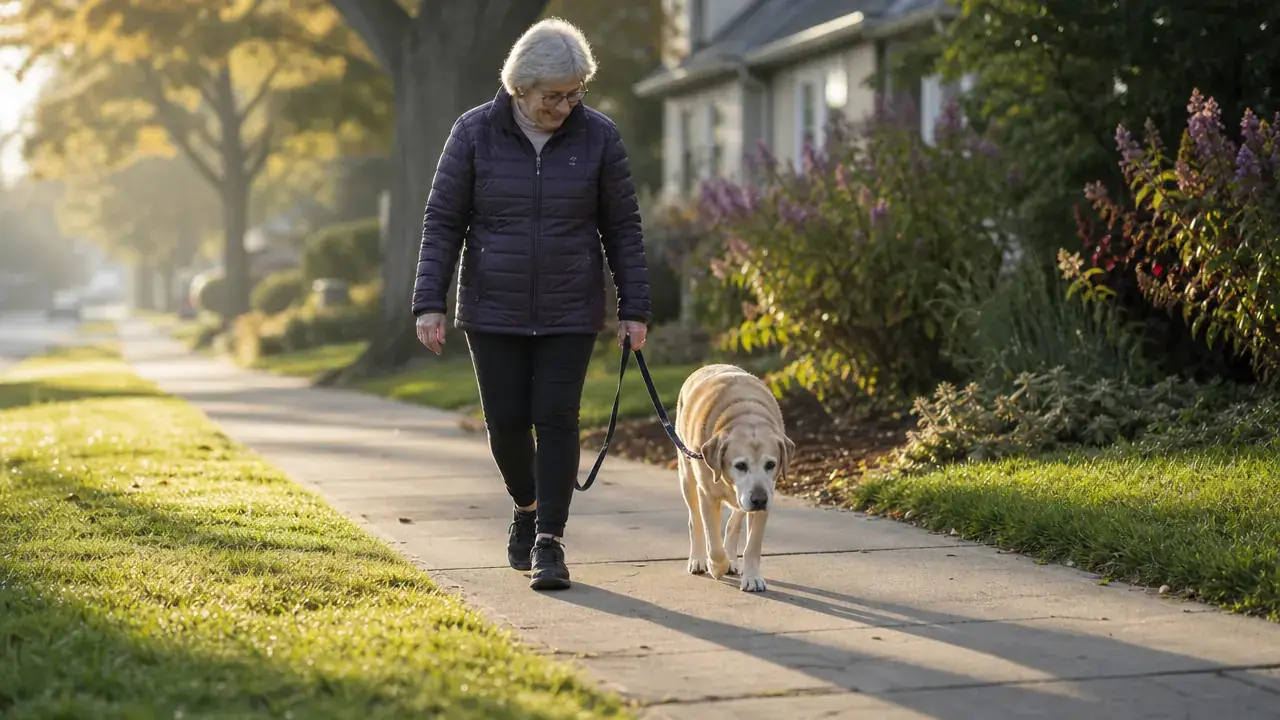
The two best substitutes for high-impact exercise in stiff dogs are slow leash walks and swimming. Slow leash walks at a controlled pace give the joint full range of motion with minimal compressive force. Swimming removes almost all weight-bearing stress while still working the hip flexors and extensors that support the joint. If you do not have access to a pool or safe water, a sniff walk where the dog sets the speed accomplishes a lot of the same low-impact movement benefit.
For Pepper, I cut out her off-leash backyard sprint sessions and replaced them with longer, slower neighborhood walks. The difference in her morning stiffness after a few weeks was noticeable. She was easier to rouse, faster to straighten up, and less reluctant to go down the back steps. The change took about three weeks to show up consistently, which is the kind of lag that makes people give up on the adjustment too early. Give it a full month before deciding it is not working.
Step 5: Manage Weight With Portion Discipline, Not Diet Swaps
Every extra pound on a dog adds roughly three to five pounds of force on the hip and knee joints with every step, depending on the gait and breed. For a beagle or similar small-to-medium breed, even one pound of excess weight is meaningful in terms of joint load. Pepper was at 28 pounds when I first noticed her joint stiffness. Her ideal weight, according to our vet, is 24 to 26 pounds. Getting her back to 26 took four months of consistent portioning but made a visible difference in how she moved on flat ground and on stairs.
I did not switch her food, which is the instinct a lot of people have. I just started measuring it. Most dog owners, myself included before I started this routine, pour a rough estimate into the bowl based on what looks right. I switched to a kitchen scale set to grams and followed the feeding guide on her food bag, then adjusted down by about ten percent to create a slow, steady loss rate. No food swaps, no expensive prescription weight-management diet, just accurate portioning every time. Combined with reduced high-impact activity, her weight came down without any dramatic interventions.
If your dog is significantly overweight rather than just a pound or two above ideal, talk to your vet before cutting calories sharply, especially in senior dogs. Rapid weight loss in older dogs can cause muscle loss, which actually worsens joint stiffness by removing the supportive musculature around the joint. Slow reduction over several months is the target. Even getting halfway to ideal weight will reduce the load on the joint meaningfully.
What Else Helps
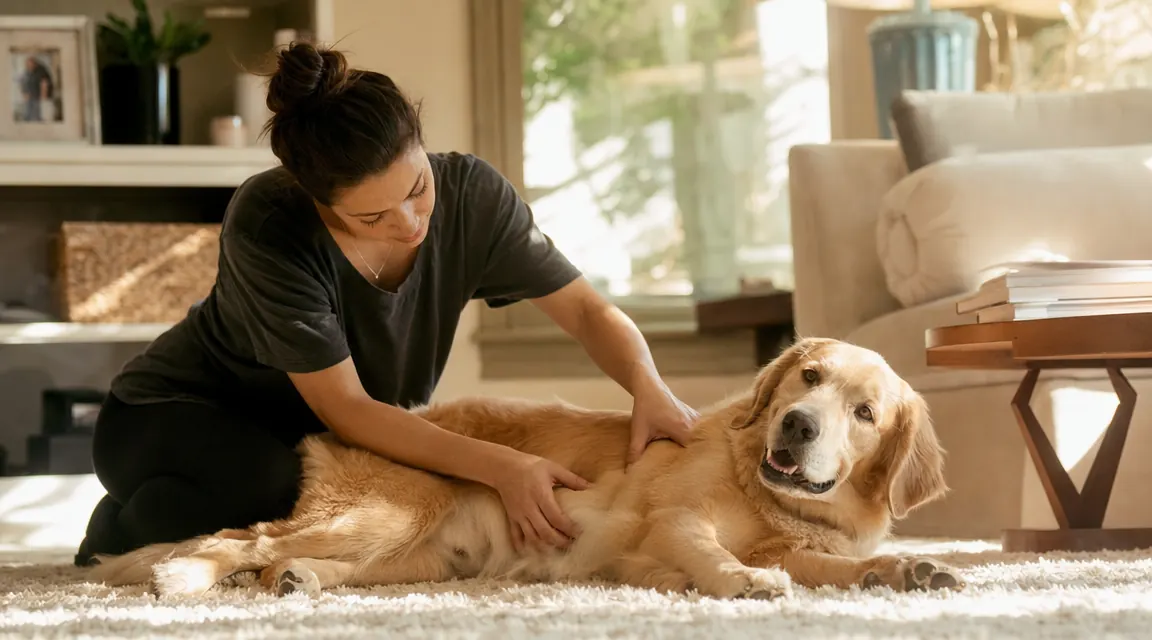
Beyond the five steps above, a few smaller habits have made a real difference in Pepper's day-to-day comfort. Gentle massage along the hip and lower back for two or three minutes after her morning walk seems to help her loosen up faster, likely by increasing circulation to the area. Use light fingertip pressure in small circles and stop immediately if the dog pulls away, vocalizes, or tenses up. Placing a warm water bottle wrapped in a towel against her hip area for ten minutes before her first walk on cold mornings also helps visibly on the worst days. The warmth reduces that initial viscosity in the joint fluid the same way the walk does, just passively. Installing a small ramp for car entry and exit was another change I underestimated. Getting in and out of a vehicle is one of the highest-impact single movements a dog does repeatedly, and removing that jump made a clear difference in Pepper's hesitation around car trips. Ramps for SUVs run twenty to forty dollars and fold flat for storage. For a dog with stiff joints, it is a worthwhile ten minutes of setup. None of these are expensive. Most are free. Together with the five core steps and a daily glucosamine supplement, they add up to a dog who moves noticeably better than she did eighteen months ago.
Getting Pepper from 28 pounds back to 26 took four months of measuring her food. That two-pound drop made a bigger difference in her joint stiffness than anything else I tried in the first year.
Start With the Supplement That Actually Gets Used Every Day
The biggest failure point in most joint stiffness routines is consistency. A soft chew that a dog eats voluntarily is the easiest way to make supplementation automatic. VetIQ Glucosamine Hip and Joint Soft Chews are what I use for Pepper every morning, and at the current price point there is no reason to skip this step.
Amazon Check Today's Price on Amazon →